Last month, Feb 2025, I was invited by Ramanujan College, Delhi University, to give an online module talk on Bhagawat Gita
The Gita is a work that has been commented by any and all, from the greatest to the not so.
What can I add?
I tried to explain the ideas in the shlokas in a way that can be understood someone not exposed to philosophy or abstract/subtle thoughts.
The aim was to help people, who are busy in the life and work, to be able to improve their lives with the application of the seemingly theoretical wisdom of Gita.
I have uploaded the videos in smaller chunks of about 30 mins.
Please check out the videos at your leisure time, 30 mins at a time.
Last month, Feb 2025, I was invited by Ramanujan College, Delhi University, to give an online module talk on Bhagawat Gita
The Gita is a work that has been commented by any and all, from the greatest to the not so.
What can I add?
I tried to explain the ideas in the shlokas in a way that can be understood someone not exposed to philosophy or abstract/subtle thoughts.
The aim was to help people, who are busy in the life and work, to be able to improve their lives with the application of the seemingly theoretical wisdom of Gita.
I have uploaded the videos in smaller chunks of about 30 mins.
Please check out the videos at your leisure time, 30 mins at a time.
Last month, Feb 2025, I was invited by Ramanujan College, Delhi University, to give an online module talk on Bhagawat Gita
The Gita is a work that has been commented by any and all, from the greatest to the not so.
What can I add?
I tried to explain the ideas in the shlokas in a way that can be understood someone not exposed to philosophy or abstract/subtle thoughts.
The aim was to help people, who are busy in the life and work, to be able to improve their lives with the application of the seemingly theoretical wisdom of Gita.
I have uploaded the videos in smaller chunks of about 30 mins.
Please check out the videos at your leisure time, 30 mins at a time.
Last month, Feb 2025, I was invited by Ramanujan College, Delhi University, to give an online module talk on Bhagawat Gita
The Gita is a work that has been commented by any and all, from the greatest to the not so.
What can I add?
I tried to explain the ideas in the shlokas in a way that can be understood someone not exposed to philosophy or abstract/subtle thoughts.
The aim was to help people, who are busy in the life and work, to be able to improve their lives with the application of the seemingly theoretical wisdom of Gita.
I have uploaded the videos in smaller chunks of about 30 mins.
Please check out the videos at your leisure time, 30 mins at a time.
Last month, Feb 2025, I was invited by Ramanujan College, Delhi University, to give an online module talk on Bhagawat Gita
The Gita is a work that has been commented by any and all, from the greatest to the not so.
What can I add?
I tried to explain the ideas in the shlokas in a way that can be understood someone not exposed to philosophy or abstract/subtle thoughts.
The aim was to help people, who are busy in the life and work, to be able to improve their lives with the application of the seemingly theoretical wisdom of Gita.
I have uploaded the videos in smaller chunks of about 30 mins.
Please check out the videos at your leisure time, 30 mins at a time.
"Like the simultaneous piercing of a bundle of hundred lotus-leaves."
Lotus leaves are very soft. Softer than the already-soft stems of lotus. A bundle of hundred lotus leaves can be pierced with a sharp needle in no time, almost instantaneously, and yet the actual process is linear. An example, which is important from another aspect as well, in Shlokavārtika says, "You say the example of lamp and light as an instance of simultaneity of cause and effect, but still there is a finite little time, just like piercing hundred lotus leaves." This also means that even then it was understood that light has a finite speed, just as it was known that sunlight takes about 8 minutes to reach the Earth.
Position and Responsibility | Do not just desire your chair, deserve it
With great power, comes great responsibility!
Watch the video.
POSITION AND RESPONSIBILITY
tat-sthānāpanné tad_dharma-lābhaḥ
तत्स्थानापन्ने तद्धर्मलाभः
“When you take that position, its responsibilities also come with it.”
You cannot just have the rights and power of the position, you need to take the duties as well. Everyone wants to be a doctor, engineer, IAS officer, lawyer, minister or the CEO, SVP, Director etc. But these positions are not just of power and money; they bring with them the responsibilities. You need to put in lot of hard work to be worthy of these positions of influence and impact.
~ Do not just desire your chair, deserve it.
Attitude Shift - Sanskrit Maxims for Contemporary Life and Leadership
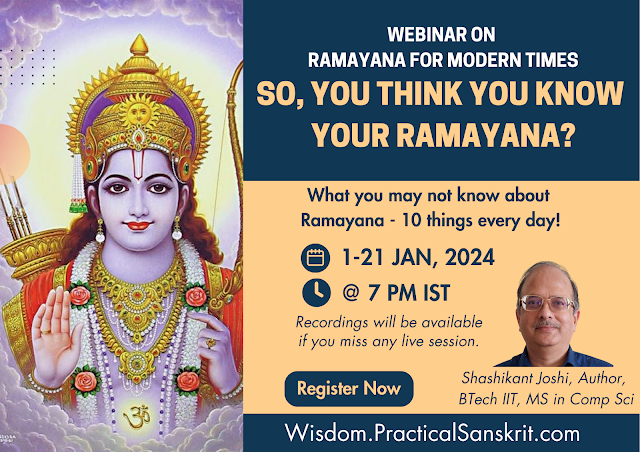
Ram Ram, Jai Siya Ram, or Jai Shri Ram – whichever one you prefer!
How well do you know Ramayana?
Why was Ayodhya called Ayodhya?
What were fair wages and tax rate in Rama’s time?
What does Rama say about destiny and karma?
There are plenty of Yes-men, but what should a leader watch out for?
What is more difficult than making friends?
What did Sita give to Hanuman as proof of their meeting?
What was the rationale behind Sita’s agni pariksha?
Bhakti and Gyan/Jnana
You may be worshipping Rama daily, or you have stopped worshipping because you became progressive or woke!
Your bhakti may be deep, shallow or non-existent, but Ramayana can still benefit you.
Bhakti is great, especially in Kaliyuga, but our Rishis always emphasized the importance of gyan, or knowing; doing something knowingly - what today we may call mindfulness, living aware etc.
Without gyan/jnana, bhakti becomes andh-bhakti, open to manipulation.
Without bhakti bhava, gyan gives rise to arrogance.
True bhakti and true gyan go together.
This webinar will also help you guide our younger and modern generations, our future, who don't follow anything, without explanation of the rationale behind it.
There is Rama in the Indian ethos in the month of January 2024.
Political affiliations aside, Ramayana is the heritage of this land for everyone living here. Beyond the TV serials, comic books, we should make an effort to understand this great epic as adults now.
Towards this purpose, I have a special invitation for you.
I am conducting a 21-days, 3-weeks long, daily, online, live webinar series from 1st to 21st January at 7 PM IST.
If you think you can't make it to all the sessions or can’t make it at 7 PM or can’t make it for any other reason, you don’t have to worry at all! Recordings of all live sessions will be made available online within a day or two after each session. So, be sure to join and register for this series.
Make this New Year even more meaningful by delving into the wisdom-ocean of our long and successful civilization and heritage. Understand why and how Rama and his story are still relevant – in modern times, modern settings, because human motivations, aspirations, desires, demotivation, sorrows etc. are still the same as in ancient times, but in a new dressing!
Please share this information with your friends and family and ask them to join as well.
Success Management: Indian perspective from Mahabharata, Panchatantra, Chanakya and others.
Come join me on Dec 11, in a webinar on Sanskrit wisdom on business and leadership!
Prior registration is required.
India has been a highly flourishing civilization for at least 3-5 thousand years, if not more. Material prosperity doesn’t come only from spirituality. A vast realm of Indian wisdom is untapped by modern thinkers and those in the making for the future.
In this short introductory series of four 1-hour sessions, we cover some ideas about economy, business, wealth, leadership, human motivations and mind as found in various popular Sanskrit works, which may not be very well known outside the Sanskrit circles. Guaranteed with informative and interesting tidbits as well as deep thought provoking wisdom, and viewpoints that you may not have thought at all.
Along with Language Curry, I am giving a webinar of 4 one-hour sessions over two weekends.
In this short introductory session of four hours, we cover some ideas about economy, business, wealth, leadership, human motivations and mind as found in various popular Sanskrit works, which may not be very well known outside the Sanskrit circles.
What is the Indian take on wealth, prosperity, economy, commerce, hard work, industry, leadership, managers, tax, learning and earning? What are the identified qualities of a wise and successful person?
Session 1:
Introduction to the aspects of Indian literature and thoughts around the topic of management, leadership, wealth and attitude towards life. It will open with some tasty samplers from various works. It will kick off with a 10-step ladder that creates a comfortable and prosperous society by creating good leaders - something modern management and leadership gurus and psychologists also grapple with. It beautifully sums up the vision and mission of any economic project and policy.
Session 2:
Mahabharata is considered the greatest epic of the world. A treasure chest of ideas and information about its time, and perennial wisdom. The greatest empire of its time and Vidura is the prime minister and one of the wisest of its characters. This session will cover many ideas from Vidura regarding administration, management, leadership, projects, long term planning and the qualities of the wise and the fool.
Session 3:
Everyone has read the animal stories of Panchatantra and Hitopadesha, thanks to Amar Chitra Katha. This session will provide a peek into the real work, which is way beyond the kids comics, but meant for future pillars of administration and government. The street smart wisdom for managers, leaders, employees alike! We will see how Indian wisdom has treated the concepts of wealth, prosperity, earning, use or lack of it, business, entrepreneurship, hard work, tax, giving, happy and unhappy boss, knowledge and application, networking and planning.
Session 4:
We will look at various Sanskrit maxims or pithy sayings that have a deep impact on modern work ethics and attitude to life and leadership.
Opium eater and the boatman; position and responsibility; Slithering lizard and Ghajani; Arundhati star in leadership; Perched eagle; Of bees, flowers and grass; Threshold lamp; Planting a mango tree; Water wheel; Crow spoils the curd and many more maxims and how they apply to workplace and life.