Showing posts with label rama. Show all posts

Thursday, December 28, 2023

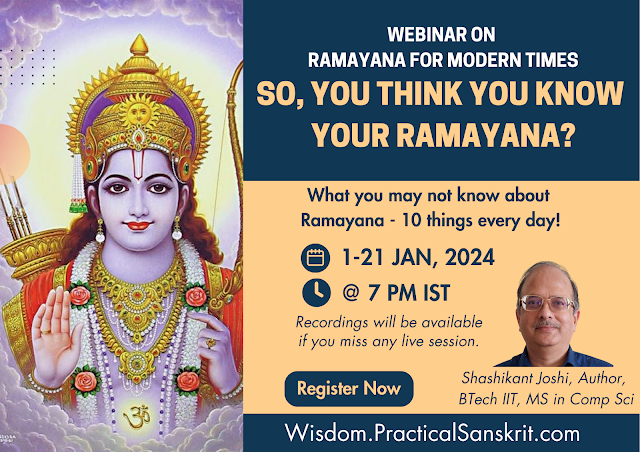
So, You Think You Know Your Ramayana? - Valmiki Ramayana Webinar Series

So, You Think You Know Your Ramayana? - Valmiki Ramayana Webinar Series


Join me for a 3-week long, 21-day webinar series on going beyond just devotion and understanding Valmiki Ramayana as well - So, You Think You Know Your Ramayana? - Valmiki Ramayana Webinar Series 


Ram Ram, Jai Siya Ram, or Jai Shri Ram – whichever one you prefer!


How well do you know Ramayana?

  • Why was Ayodhya called Ayodhya?
  • What were fair wages and tax rate in Rama’s time?
  • What does Rama say about destiny and karma?
  • There are plenty of Yes-men, but what should a leader watch out for?
  • What is more difficult than making friends?
  • What did Sita give to Hanuman as proof of their meeting?
  • What was the rationale behind Sita’s agni pariksha?

Bhakti and Gyan/Jnana

You may be worshipping Rama daily, or you have stopped worshipping because you became progressive or woke!

Your bhakti may be deep, shallow or non-existent, but Ramayana can still benefit you.

Bhakti is great, especially in Kaliyuga, but our Rishis always emphasized the importance of gyan, or knowing; doing something knowingly - what today we may call mindfulness, living aware etc.

Without gyan/jnana, bhakti becomes andh-bhakti, open to manipulation.
Without bhakti bhava, gyan gives rise to arrogance. 
True bhakti and true gyan go together.

This webinar will also help you guide our younger and modern generations, our future, who don't follow anything, without explanation of the rationale behind it.


Webinar Series on Understanding Deeper Wisdom of Ramayana

There is Rama in the Indian ethos in the month of January 2024.

Political affiliations aside, Ramayana is the heritage of this land for everyone living here. Beyond the TV serials, comic books, we should make an effort to understand this great epic as adults now.

Towards this purpose, I have a special invitation for you. 

I am conducting a 21-days, 3-weeks long, daily, online, live webinar series from 1st to 21st January at 7 PM IST. 


If you think you can't make it to all the sessions or can’t make it at 7 PM or can’t make it for any other reason, you don’t have to worry at all! Recordings of all live sessions will be made available online within a day or two after each session. So, be sure to join and register for this series.

Please visit Wisdom.PracticalSanskrit.com to register today.

Make this New Year even more meaningful by delving into the wisdom-ocean of our long and successful civilization and heritage. Understand why and how Rama and his story are still relevant – in modern times, modern settings, because human motivations, aspirations, desires, demotivation, sorrows etc. are still the same as in ancient times, but in a new dressing!

Please share this information with your friends and family and ask them to join as well.


Raam Raam!


(c) Shashikant Joshi । शशिकांत जोशी । ॐ सर्वे भवन्तु सुखिनः ।

Friday, August 7, 2020

Rama - the best among men. But why?


You don't wanna miss this

LIVE, ONLINE on AUG 8
#1 10 am New Delhi and, 
#2 10 am New York (730 pm India)
(Join any one session)

RAMA - the best among men
but why?

Exploring some aspects of the timeless wisdom of:
Rama - the universal hero

You will come away with more subtle knowledge about Ramayana and Rama.
Leadership. Ideals of life. Inspiration.
Addressing some popular controversial topics as well!

Presented by Shashi Joshi, IIT Kharagpur, PracticalSanskrit.com

To join the FREE, LIVE session, signup at PracticalSanskrit.com now!
(One time signup, gives you access to all future live sessions)


(c) Shashikant Joshi । शशिकांत जोशी । ॐ सर्वे भवन्तु सुखिनः ।
Tuesday, August 4, 2020

Rama does things perfectly the very first time.


Rama doesn’t aim twice, doesn’t establish the refugee twice, doesn’t give twice to a seeker, Rama doesn’t speak twice (the same thing). He does it perfectly the very first time.


द्विः शरं नाभिसन्धत्ते द्विः स्थापयति नाश्रितान् ।
द्विर्ददाति न चार्थिभ्यो, रामो द्विर्नाभिभाषते ॥
(हनुमान्नाटक १-४८)


सन्धि-विच्छेद -
द्विः शरं न अभिसन्धत्ते द्विः स्थापयति न आश्रितान् ।
द्विः ददाति न च अर्थिभ्योः, रामः द्विः न अभिभाषते ॥


(राम) बाण को दो बार निशाने पर नहीं साधते,
(राम) शरणागत आश्रित को दो बार स्थापित नहीं करते,
(राम) माँगनेवाले को दो बार नहीं देते,
राम (एक ही बात) दो बार नहीं कहते।
अर्थात् एक ही बार में कार्य पूर्ण करते हैं, दूसरी बार करने की आवश्यकता ही रहती।

शब्दार्थ:
द्विः = दो बार; शरं = बाण; न = नहीं; अभिसन्धत्ते = साधते ।
द्विः = दो बार ; स्थापयति = स्थापित करते; न = नहीं; आश्रितान् =शरणागत आश्रित को।
द्विः = दो बार; ददाति = देते ; न = नहीं; च = आउर्; अर्थिभ्योः = माँगनेवाले को।
रामः = राम; द्विः = दो बार; न = नहीम्; अभिभाषते = बोलते (एक ही बात को) ।

----------------

dviḥ śharaṃ nābhisandhatte dviḥ sthāpayati nāśhritān |
dvirdadāti na chārthibhyo, rāmo dvirnābhibhāṣhate ||
(hanumānnāṭaka 1-49)

Sandhi-break -
dviḥ śharaṃ na abhisandhatte dviḥ sthāpayati na āśhritān |
dviḥ dadāti na cha arthibhyo, rāmaḥ dviḥ na abhibhāṣhate ||

Meaning:
Rama doesn’t aim twice, doesn’t establish the refugee twice, doesn’t give twice to a refugee, Rama doesn’t speak twice (the same thing). He does it perfectly the very first time.

Word for Word meaning:
dviḥ = twice; śharaṃ = arrow; na = not; abhisandhatte (aims) |
dviḥ = twice; sthāpayati = establishes; na = not; āśhritān = the refugee (Sugreeva, Vibhishana) |
dviḥ = twice; dadāti = give; na = not; cha = and; arthibhyoḥ = to the seeker|
rāmaḥ = Rama; dviḥ = twice; na = not; abhibhāṣhate = speaks (the same words)||

The refugee is a reference Sugreeva and Vibhishana.


(c) Shashikant Joshi । शशिकांत जोशी । ॐ सर्वे भवन्तु सुखिनः ।

Friday, April 3, 2020

Perseverance, effort, enthusiasm is the greatest power!


On April 3rd, 2020, Prime Minister of India, Shri Narendra Modi, addressed the nation a second time since the nationwide lock down due to the unprecedented situation of the pandemic of Novel Corona virus or Covid19. He also used a Sanskrit shloka in his speech.

A short background leading up to this speech maybe helpful.

On 19th March, the PM asked the country to observe a voluntary curfew, called 'Janata curfew' or "People's Curfew" on 22nd March, from 7 am to 9 pm. He also asked the people to make noise at 5 pm, by banging steel plates, or blowing conch, whistles etc to acknowledge and thank the people serving at the front - doctors, nurses, medical staff, police, sanitation workers, delivery people and other essential services who were risking their lives by being at the front line and serving the rest of society. This 'ritual' was to bring about awareness among the people about the front line workers and about the importance of the pandemic.

After this, from 24th March onward, India has been under a lock down for 21 days.

For a country like India, with 1.3 billion people, of all faiths, mental maturity, age, type, it is not easy that everyone gets the message and its urgency. The govt and the relevant people are doing the best they can under the circumstances, and so far India has handled the situation very maturely and with great results. Hope this remains going further as well. There are many sites and social media outlets with latest information about the pandemic, govt steps, etc. Govt India site, John Hopkins etc.

After ten days, the Prime Minister spoke to the nation on the 3rd of April. Many were expecting serious announcements. The relevant departments are being updated with the necessary details. What the people need is also a feeling of being together, not feeling down or depressed or let down. In such times, when doing nothing is doing everything (stay put at home), how do you connect with the people and keep their morale up?

The PM gave a touching hope filled speech, addressing not just the urban few, but the rural many. Many in the villages, second and third tier cities and towns. India, the ocean and land of rituals. Where every important thing has a ritual associated with it.

He asked everyone that on 5th April, Sunday, to light a lamp, shine a flashlight etc at 9 PM for 9 mins from their balconies or main door. Not to disobey social disobedience.

India has a long tradition of ritual of lighting the lamp. From the famous 'Lead me from darkness to light' (तमसो मा ज्योतिर्गमय, tamaso ma jyotirgamaya), to the lamp lighting ceremony in the beginning of any important function or gathering - lighting the lamp is very important, and every person of the land understands this symbolism.


In these times of national lock down and possibly feeling helpless, he cited a Sanskrit shloka to urge people to keep their hopes high, enthusiasm up. The media reported 'The Prime Minister recited the Sanskrit shloka from the Mahasubhasitasamgraha, a collection of Sanskrit aphorisms collected from various sources.' But the source of the shloka was not mentioned. A collection doesn't compose the shloka, just compiles it.


The shloka is from Ramayana, Kishkindhakanda, sarga 1, shloka 121.

In the previous section, the story narrated that Rama and Lakshmana were wandering in the forest looking for any clues for Rama's wife Sita, who was kidnapped. When they fought and killed Kabandha, a rakshas, he suggested that they go to Kishkindha and find Sugreeva, who can help them. Right after this they meet Shabari as well.

Kishkindha kanda starts with Rama at Pampa sarovara. And he starts talking to Lakshmana, sharing is yearning for his dear Sita:
"See these forests enriched with flowers; these flowers already fallen, in fall, and still on the trees, the wind is playing with the flowers. When the wind shakes the flower laden branches and moves ahead, the bumblebees also follow it humming in its praise. The caves are singing in high notes (the wind blowing in the cave mouth), the cuckoo sings in accompaniment, and looks like the wind is teaching the trees to dance. The breeze that blows through the mountain sandalwood is so fragrant, and remove the fatigue. It seems the trees - whose branches have flowers at their tips, and bees seems like their turbans, and are swaying - have started to dance and sing as well (after being trained by the wind). All this just adds to my anguish of separation from Sita. The water fowl singing happily near the waterfall, Sita loved to listen to it. She would call me as well to listen to it. 
Looks like this Spring in the form of fire will burn me inside. The red Ashoka flowers are its amber, new buds are its flames, and the bumblebees are the crackle of the fire. If I can't see my Sita again, what is the purpose of this life? These peacocks are dancing so happily enticing the peahens, seem to be mocking me. This Spring must be also where Sita is. How will she bear the torture of separation? She is so soft spoken, young, loves me so much, I am afraid she may not survive being away from me. 
See, Lakshmana, the red lotuses all over Pampa, appear like morning Sun. What all things I loved when with Sita, all of them appear distasteful now. The lotus petals remind me of her eyes. The thick beds of flowers fallen on the ground appears like a soft royal bed. 
Oh! The lotus-eyed, delicate, daughter of Janaka, my dear Sita - how must she be holding on to her life breath without me! Lakshmana, when the righteous and just king Janaka will ask me about Sita in the gathering of people, what will answer him? (about safety of Sita). 
Oh! When I was exiled by father's order, the one who accompanied me out of her sense of dharma, that my dear Sita, where is she right now? Upon going back to Ayodhya (after the exile term is over), when queen Kausalya asks about her daughter in law, what should I tell her?
Lakshmana, you go. You go back to Ayodhya and meet dear brother Bharata. I can't live without Sita now."

Seeing the great Rama, his brother, mourn like a helpless man, Lakshmana spoke thus:
O best among men Rama! May good be unto you. Please regain composure. Get hold of yourself.
The intellect of a great man like you should not be devoid of enthusiasm. "Everyone has to bear the sorrow of separation from dear ones" - remembering this you should shed excess sneha (affection); because even a damp wick, if immersed in enough sneha (oil, the other meaning of sneha) will start to burn.
If Ravana has gone to nether worlds, or even further, he won't be able to live for long anyways. O Noble Rama, you should have dhairya (patience, forbearance). Abandon these thoughts of a weakling. If someone's wealth or effort is wasted, if they don't put effort enthusiastically, then they won't accomplish their goals.
O Noble sir (Rama), Enthusiasm is very powerful. There is nothing more powerful than enthusiasm. Verily, there is nothing unattainable in this world for the enthusiast.


Shloka in Devanagari:
उत्साहो बलवानार्य नास्त्युत्साहात् परं बलम् ।
सोत्साहस्य हि लोकेषु न किञ्चिदपि दुर्लभम् ॥ (रामायण, किष्किन्धाकाण्ड १.१२१)

    उत्साहः बलवान् आर्य न अस्ति उत्साहात् परं बलम् ।
    स-उत्साहस्य हि लोकेषु न किञ्चित् अपि दुर्लभम् ॥


Shloka in IAST:
utsāho balavānārya nāstyutsāhāt paraṃ balam |
sotsāhasya hi lokeṣhu na kiñchidapi durlabham || (rāmāyaṇa - kiṣhikindhā-kāṇḍa 4-1-121)

    utsāhaḥ balavān ārya na asti utsāhāt paraṃ balam |
    sa-utsāhasya hi lokeṣhu na kiñchit api durlabham || (with sandhi break)


Word for word meaning:
उत्साहः बलवान् = utsāhaḥ balavān = enthusiasm [is], powerful
आर्य = ārya = O Noble sir
न अस्ति = na asti = not, is
उत्साहात् = utsāhāt = (more) than enthusiasm
परं बलम् = paraṃ balam = more, power
स-उत्साहस्य हि = sa-utsāhasya hi = of the enthusiast, surely
लोकेषु = lokeṣhu = in the world
न किञ्चित् अपि = na kiñchit api = not, anything, even
दुर्लभम् = durlabham = [is] difficult to attain.

O Noble sir (Rama), Enthusiasm is very powerful. There is nothing more powerful than enthusiasm. Verily, there is nothing unattainable in this world for the enthusiast.


(c) Shashikant Joshi । शशिकांत जोशी । ॐ सर्वे भवन्तु सुखिनः ।

Wednesday, April 1, 2020

Best wishes for Ramanavami !


One of the most popular prayers to Lord Rama is created by Tulasi-dasa, who also retold the entire story of Rama for this times, in his historic Rama-charita-manasa.


श्रीरामचन्द्र कृपालु भजु मन

श्रीरामचन्द्र कृपालु भजु मन, हरण भव-भय-दारुणम् ।
नव-कञ्ज-लोचन कञ्ज-मुख , कर-कञ्ज पद-कञ्जारुणम् ॥१॥

कन्दर्प अगणित, अमित छवि, नवनील नीरद सुन्दरम् ।
पट-पीत मानहु तडित रुचि-शुचि, नौमि जनक-सुता-वरम् ॥२॥

भजु दीन-बन्धु दिनेश दानव-दैत्य-वंश-निकन्दनम् ।
रघुनन्द आनन्द-कन्द कौशल-चन्द दशरथ-नन्दनम् ॥३॥

शिर-मुकुट कुण्डल, तिलक चारु, उदार अङ्ग-विभूषणम् ।
आजानु-भुज शरचाप-धर सङ्ग्रामजित-खरदूषणम् ॥४॥

इति वदति तुलसीदास शङ्कर-शेष-मुनि-जन-रञ्जनम् ।
मम हृदय-कुञ्ज निवास कुरु कामादि-खल-दल भञ्जनम् ॥५॥


English transliteration:


shrī-rāma-chandra kṛipālu bhaju mana (Pray to Merciful Rāma, O Heart)

shrī-rāma-chandra kṛipālu bhaju mana, haraṇa bhava-bhaya-dāruṇam |
nava-kañja-lochana kañja-mukha , kara-kañja pada-kañjāruṇam ||1||

kandarpa agaṇita, amita chhavi, nava-nīla nīrada sundaram |
paṭa-pīta mānahu taḍita ruchi-shuchi, naumi janaka-sutā-varam ||2||

bhaju dīna-bandhu dinésha dānava-daitya-vaṃsha-nikandanam |
raghunanda ānanda-kanda kaushala-chanda dasharatha-nandanam ||3||

shira-mukuṭa kuṇḍala, tilaka chāru, udāra aṅga-vibhūṣaṇam |
ā-jānu-bhuja shara-chāpa-dhara saṃgrāma-jita-khara-dūṣaṇam ||4||

iti vadati tulasī-dāsa shaṃkara-shéṣa-muni-jana-rañjanam |
mama hṛidaya-kuñja nivāsa kuru kāmādi-khala-dala bhañjanam ||5||


Meaning:

O heart! pray to the merciful, compassionate Shri Rāma!
who takes away the terrible fears of the mortal world |
eyes like new lotus, lotus-faced,
lotus hands, even feet are like red lotus ||1||

The eternal image (exceeding) innumerable Kāmadeva,
beautiful like new water-bearing clouds |
And the yellow garments appear (on the dark complexion) like lightning,
I bow to the husband of the daughter of Janaka ||2||

Pray to the 'Friend of the Weak', (brilliant like the) sun,
Up-rooter of the Dānava and Daitya |
Son of Raghu dynasty, root of all joy,
Darling of Kaushalyā, son of Dasharatha ||3||

Head with the crown; ear-rings, tilak look beautiful,
and the body is generously adorned with jewelry |
The long-armed one, won the battle
with Khara-Dushana by beheading them||4||

Thus says Tulasīdāsa (the poet) - The giver of joy
to Shiva, Shesha-nāga, thinkers, people|
Make residence in my heart,
O killer of the 'group of evils' like desire (anger etc)||5||


Listen to this melodious rendition of the same.


And this:


(c) Shashikant Joshi । शशिकांत जोशी । ॐ सर्वे भवन्तु सुखिनः ।

Saturday, August 8, 2015

Was Ramayan real or mythology?

When it comes to Ramayana and Mahabharata, Indians are missing a very grave point, which has only been brought in debate by external factors. Did Ramayana actually happen? Did Hanuman have a tail? How could a monkey fly?

No such questions are asked of Yoda, Spider-man, Wonder-woman or Avengers.

What you have in Ramayana and other epics is to bring in the story element as well. Don't forget that these were written/composed specifically to impart Vedic wisdom to those who don't have the aptitude, attitude or time for the subtle revelations of Vedic seers, distilled after a long lifetime. I am not exaggerating or kidding.

E=mc^2 has no meaning to the uninitiated yet it not Einstein's fault.
To make it interesting a prof like Feynman or some one may create a whole kids' drama with characters like Mr Photon, Mrs Energy, Master Mass, and Prof ZappedHair and so on.
Will this play be mythology?
Will you debunk it every time and rather than focus on the message focus on the feasibility of a talking Mr Photon?

Next time someone asks these questions to you, simply answer this:
Focus on the message, and the super story-telling of the ancients, like you do with Spiderman's 'With great power comes great responsibility.' Respected speakers paid by the $1000s/hour will quote this and be applauded.

So, read the story of Ramayana, enjoy the story telling if you are kid at heart, and if you are a bit grown up in the mind, marvel the deep wisdom scattered all over in the dialogues of characters.

Don't analyze people's faith in Rama or Hanuman, be it your grandmother or the maid. Encourage it. With that, encourage understanding the message.

As Vidura (and later Kabir) points out, one of the trait of the wise is to grasp the essence.

At various stages of your growth, the essence will keep shrinking. As a kid it is an ultimate truth that Hanuman flew with the mountain on his pinky and what not. At 80 you may be seeing Hanuman in everything and person and understand it as the roaming atma looking for the parama-atma, the source; and devoting to the supreme for no selfish motive (unlike Sita, Lakshman, Sugreev, Vibhishan, Angad etc who all had some duty or interest to be with Rama).
Hanuman was the only one who had no reason to be loyal to Rama, and was the only one who was immediately attracted to Rama.

If you remember his childhood, he can go anywhere (immense powers of imagination?) being the son of wind, and when he goes to eat the Sun, Indra intervenes, hits him with vajra and the kid monkey falls, breaks his chin (hanu) and thus gets the name Hanuman (the one with the [broken] chin).

Then all gods (symbols of powers) give him supreme powers, and the kid becomes mischievous and disturbs everyone. The RiShis can't take his powers but can make him forget till someone reminds him.

That is us, with immense power but no recollection. When the need arises, some arise and become Hanuman, rescuing the situation. Others keep sleeping.

Did Ramayana really happen? If not, I will stop taking Rama and his message seriously?
The question is - did it ever stop happening?
It happens in all of us, all the time.

If you can't get the metaphor, enjoy the story, and call Hanuman as Yoda or c3po or whatever, but don't lessen the joy of a story, then you lose the story, and never got the message to begin with (double whammy!)


A very valid point brought out by a friend:
"Totally agree with you about Ramayana (and Mahabharata) still playing out in people's lives in some form or the other. But why should one not enjoy the story, get the metaphors, AND look for historical clues in the epic? Given that this was composed a very long time ago, there are bound to be historical clues. Let's not ignore them."
Sure, but there will be no point researching if monkeys can fly or if Hanuman's tail could grow infinitely in the court, there will be no such species possible who can increase its body mass and length to such proportions. Lizards can grow a tail but that too takes a few hours/days.

Surely, researchers of language, society etc. take Ramayana and Mahabharata seriously for its depiction of the flora, fauna, geography, society, norms, values. That is how they even accuse Hindus of having a woman-oppressing society based on Sita's agni-pariksha etc. (which is a detraction actually, but that is another topic).

So scholars use them for tracking history.

But it should be reasonable. For example, another interesting point could be - there is no mention of script in Ramayana! Does that lend any credibility to its antiquity?  
So, 
Stop questioning 'Was it real?'
Start questioning 'What does it mean?'
 
--------------------------------
[Added 9th Aug 2015]

A lot of discussion went over in FB. Here is my recent summarizing comment (after a lot of comments by others):

Interesting discussions, viewpoints.

The main intention for the article was for people who believe in ancient Indian scriptures and thoughts (this is the widest net I can throw that captures all people who believe in the Indian thought system of Sanatana Dharma aka 'Hinduism' and its offshoots) when they may face other detractors who have nothing better to do, by choice or design, the detractors have used such logic of 'scientific inconsistencies' and tried to debunk them.

For those situations, remember, the essence is the wisdom, the serenity the deep messages give us. These messages whether originally from God, Rama, Vishnu or anyone (actually immaterial), were transmitted to us via humans (very wise and caring humans, RiShis, AchArya-s etc.) and have a lot of value.

This value is enhanced if one has some level of faith, liking, respect for the scriptures. (You can replace this in any other religion's case as well, but there will be a difference pointed out later between the two). Even the wise seers themselves say for search of any truth - truth is obtained from shraddhA (respectful belief in something, that is you can't keep doubting everything all the time, you can question, and inquire but still need faith, even if it is in the scientific process itself, even if it is in logic itself. A logical person will not forget that human beings are full of emotions and other illogical things as well)

So, have respectful faith in the scriptures, even if you don't fully understand them, but also, try to understand them as well, feel them as well. Your duty is not over merely by paying physical respect to them like folding hands and offering flowers. It has to be followed by understanding it, experiencing it, and liberating yourselves, or at least being a nice human being in the society.

While these apply to all religions, the basic difference between Sanatana Dharma principles and other religions is - Hinduism doesn't invoke violence against others based on opinions, beliefs etc; it only invokes appropriate action against illegal, unethical, unjust people based on their actions to keep an order in the society. That is why you can see greatest extent of variety only in Indian society (and possibly China). This is unfathomable for outsiders to grasp, and they try to simplify, which causes problems.

While others go outright on attack mode (physical or on thoughts) to curb and convert for politico-religious gains.

Why this difference? If you find any blatantly wrong in any later scripture, you can refer to a previous one and get clarification. And usually, when wise and experienced people apply sound judgement to the truths of the ancient times and interpret them honestly for the changed time and space, you get good results. In case of Hinduism, such people are becoming less and less who can understand, interpret, caring for all, open to change keeping greater good in mind; in case of others, their single book allows no other interpretation, even if they were to land on planet X6Z-317 in upper Andromeda or what ever you have. They will still have the same one book for inner growth and that is the problem.

But that is not what I wanted to say in this post. I am not going to that side.

I am addressing only to those who have something to do with the Indian scriptures. What should they keep in mind, when distracted? That was the only point of the post.

It is a weird and sad situation where every statement has to be clarified with ten footnotes and 5 disclaimers else someone or the other will give it another spin. smile emoticon smile emoticon No conversation can continue without some basic common ground and understanding,

All ideas are most welcome.


(c) Shashikant Joshi । शशिकांत जोशी । ॐ सर्वे भवन्तु सुखिनः ।

Wednesday, May 28, 2014

Good governance and 16 percent tax


After the recent government change in India, with the promises and expectations of development and good governance, let us look at some signs of good governance from Sanskrit sources. We can learn some Sanskrit while discussing relevant modern topics as well.

"The guilt/crime/sin that a king gets, whose people are unprotected even after taking one-sixth (of the income as tax), may the he get upon whose counsel Rama went to exile in the forest."

The background of this shloka from Ramayana is when Rama’s brother Bharata comes back from Kekaya to find Rama has gone at the behest of his own mother Kaikeyi. When Rama’s mother Kaushalya scolds him, a sad and repentant Bharata says he had nothing to do with this. And then as if to prove his point, he hurls the curses on the one who instigated this whole thing. When today’s curses are of lowest level possible, the curses that Bharata gives show the elegance of the writer Valmiki and the high standards of the society and its elites.

From the above curse of Bharata two things are very clear.

One, it was a serious matter that a person doesn't do his duty. Dharma is one’s chosen duty. A king’s duty is to protect and prosper the citizens. That is the reason the tax is collected. Not for the enjoyment of the king. The king simply gets his salary (a higher but limited salary). If a king does not do that even after taking the tax, he is guilty, sinner, criminal; whichever way you want to look at. And this was so grave a matter, that Bharata curses the instigator with this grave curse.

Two, the tax at that time was one-sixth. That is 16%. And Ayodhya was one of the richest city of its time. And it was called the Golden Goose (Sone ki Chidiya in Hindi). And the world clamored to come here, in peace and in violence and in deceit, but came they all!

Why is it not possible today to have 16% tax and all the benefits, riches. Because the greedy corporations siphon off the resources of the society. The corrupt politicians swindle the money.

Even if we simply stop the corruption of present day (lakhs of crores of Rupees), we can lower the tax rate and still make progress. If we are able to get the Swiss bank black money of Indians then we will know what development can be.

There is enough to fulfill everyone’s needs
but not enough for even one person’s greeds.


And now the language aspects -


bali = sacrifice (tax)
ShaD = sixth
bhAgam = part (sixth part of the income)

uddhRitya = having taken, after taking (ut- = up, out; + hRit = to take away; + -ya = prefix to denote ‘after having done’)

nRipasya = of the protector (-pa) of people (nRi)

arakShitaH = unprotected (a- = not; rakSh = to protect; rakShitaH = protected)
prajAH = subjects of the king, citizens, people of a land (literally those that are born, generations, descendants)

adharmo = adharmaH = not right/just/fair (the guilt/sin of not being right) [ dharma = dhArayati iti dharmaH, right thing/action at the right time ]
yo’sya = yaH asya = that which is of such a king (whose people are unprotected even after 1/6 tax) [yaH = that which’ asya = of this]
so’syAstu = saH + asya + astu = that be of him [astu = may it be]
yasyAryo’numate = yasya + AryaH + anumate = upon whose counsel Rama [AryaH = noble, sir, contextually rAma; mati = thought, opinion; anumata = counsel, advice; anumate = in/by the advice of ]
gataH = went (to exile) [gaM = to go; gataH = that which is gone]


Pronunciation help with other Sanskrit words used in text:
rAmAyaNa रामायण ; bharata भरत ; kaikeyI कैकेयी ; kaushalyA कौशल्या ; vAlmIki वाल्मीकि ; dharma धर्म


(c) Shashikant Joshi । शशिकांत जोशी । ॐ सर्वे भवन्तु सुखिनः ।

Saturday, March 24, 2012

The greatness of Rama - The Ideal Man.

This week we are doing Rama week on Facebook. Please join us there as well.


Today morning I got up to see a link to a video on the Facebook Page by a member, Varsha Gokhale. The video is from some Indian TV serial on Rāma, and I started to watch it just like any other link. I started watching it with no expectation, after all it is some TV serial, which they are making dime a dozen on bhakti these days. But while watching, so many thoughts ran through the mind, outpaced only by the feelings in the heart, that this post had to be written.

Many times we only use our brain, but sometimes, it is okay to use our heart, and feel things. Even if we are men. Before you see the video, I want to set the right background, for those who do not know the (details of the ) story of Rāma.

Brief storyline.
Rāma is the eldest prince, and his coronation for tomorrow has even been announced. His stepmother Kaikeyī calls due the rain check on the boons her husband had given her for saving his life in the battlefield someday in the distant past. Kaikeyī, brain washed by her hunchback maid Mantharā, asks for Rāma to be exiled (can not enter any human settlement, not just Ayodhya) and the throne for her own son Bharata. Everyone opposes this; Lakṣhmaṇa even suggests taking the empire by force. But Rāma leaves, saying that snatching the throne against elders’ wishes will set a bad example to people.

When Sītā and all the citizens ask to accompany him, he says it is his sentence to fulfill, not theirs. But Sītā follows giving the argument of 'a wife must never leave her husband' (Till death do us part?) and Lakṣhmaṇa becomes his ‘slave’ and hence a master must take his servant.

He spends many years in the jungle, helping people, learning about the land, making bonds with forest dwellers. Sītā is kidnapped by Raāvaṇa by force and kept in Laṅkā. Rāma, who was banished from entering any civilized settlements, with the help of Sugrīva and Hanumān and their army, fights the mighty sorcerer Rāvaṇa and his brothers, his armies, and finally wins. Rāvaṇa was invincible by the boon of Brahmā the Creator not be killed by anyone but humans and animals, so Rāma, the human avatāra of Lord Viṣhṇu, was finally able to kill Rāvaṇa.

The Fire test.
After that, still in the battlefield, he says to Sītā, "I have cleared my name as a warrior who could rescue his wife. Now you are free to go anywhere you wish, and marry anyone you wish." Everyone is shocked by this, for the months long battle with heavy casualties was fought to get Sītā back. Even the Creator Brahmā himself tells Rāma, "Have you forgotten O Lord, that you are Viṣhṇu himself, and have descended to earth only to deliver it of the tortures of sinner. Now that is over, why are you not seeing your own consort Lakṣhmī standing in front of you?"

Sītā, thus humiliated, asks for the pyre to be built and says if she is pure, fire would not harm her. Indeed, Fire God Agni comes and delivers her with a certificate of purity.

Rāma says, "I knew all along, you were pure and will always be and fire could not harm you. But how would I have convinced all these people, who don't understand your divinity? Words would not have sufficed to clear your name."

In later additions to the story over ages, it is further added, that even while she was expecting, upon hearing a washer-man's allegations against Sītā, Rāma sends her to the āshrama of Sage Vālimīki, where she stays and gives birth to twins.


Here is a video, from one of the TV serials in India, the story is after pregnant Sītā has left the palace for āshrama. Sītā is needed for the fire ritual, yajña (यज्ञ). The only way out is to have a statue of hers sitting next to Rāma during the ceremony. Being emperor, of course it has to be a golden status. In the video, he is talking to the sculptor, who is blind. Sculptor requests Rāma to tell how Sītā looks, what is like, so he can make the statue. I agree that much more could be said about Sītā, but for once, look at Rāma, not as divine, but as human, that he portrayed all along.

Imagine yourself in his position -

- Heir to the greatest empire of its time, everyone loves you, respects you.
- You are eldest of four brothers, have been recently married to the most beautiful girl in the world.
- You are going to be the crown prince tomorrow.
- Because of the instigation of the hunchback maid of your step mother, she asks you to leave for 14 years of exile and throne goes to your step brother.
- You take everything smiling and leave, even when your mighty bother is ready to fight and take by force, even when your repentant father asks you to imprison him and overrule him.
- You spent life in one long camping picnic, interspersed with fighting demons and fetching water from pure flowing river, taking afternoon naps after a sumptuous lunch made by your dear wife, with whom you spend most of the time, since there is nothing else to do, you discuss matters of polity, culture, relationship, administration and everything.
- She is kidnapped.
- You weep like a madman, asking plants and birds to give you a clue.
- You make some allies.
- You find out she is on an island, trapped by the most powerful demon, who has defeated even the gods.
- You fight, help others, get help, and make the longest man-made bridge out of stones thrown in the ocean.
- You fight the master of deception, master of arms, and sorcery and one by one, with casualties on both sides, win the war.
- You are dying to meet your wife, for who you have done all this.
- You are forced to say to her 'You are free to go anywhere and marry anyone, for I know not what your character has been', while knowing very well that she is pure and you, as the new king, can very well afford to not care about anyone in the world thinks.
- She proves out to be pure, you return to be the king.
- She is expecting, there are rumors, and you once again let her go.
- Now you need a statue made of her for some ritual that requires it.
- And the blind sculptor asks you to describe her to him.

WHAT DO YOU SAY?
HOW DO YOU DESCRIBE SOMEONE WHO IS IN EVERY CELL OF YOUR BODY?
WHO HAS NEVER BEEN ANYWHERE BUT IN YOU?
WHO HAS BEEN THE FORCE THAT SAW YOU THROUGH TOUGH TIMES?
WHO WAS PUT TO ANGUISH TWICE ONLY FOR THE SAKE OF YOUR DUTY AND ROLE IN SOCIETY.


Let us watch the video. For once leave aside all logic, brains, and feel with your heart, the pain of a man bound by his duties, principle, and yearning for his love of life.

When the sculptor asks to describe Sītā, he starts saying she is the best woman, best daughter, best wife, best daughter-in-law.
And then he quivers with sorrow, remembering that she was expecting when she left the palace. And he remembers all the wonderful time they had spent during their extended forest camping of fourteen years. Imagine today, how much time do we give our spouses in a 24 hour period? Spending all your time together would have made the bond all that much stronger!

Then he describes Sītā to the sculptor in verse. I am giving the Hindi words for those can read, and meaning for those who cannot. Subtitles are also there on the video.
परिचय कर सौन्दर्य सृष्टि सेGet introduced to the creation of Beauty
देख सिया को मेरी दृष्टि सेSee Sītā through my eyes
वरदानी चरणों से गति लेTake nirvāṇa (gati) from boon-giving [auspicious] feet
मूर्ति बनाने की अनुमति लेTake permission to make her statue
कटि कोमल कर-कमल सुहानेSlim waist, enticing hands soft and pink as lotus
बाहों का हार बनाना जानेKnew how to make a garland of the arms
है देदीप्यमान मुखमण्डलHer face has a divine brilliance
गहरे नयन-श्याम, बिन काजलDeep eyes are black without applying kohl
मस्तक पर सूरज की प्रभा हैForehead stands tall and shining like the Sun
केशों में घनघोर घटा हैIn her tresses are the deep rain bearing clouds
हर नाते की हर छवि प्यारीEvery memory of every interaction is dear
मन से देवी, तन से नारीA woman by body, a Goddess by heart
जब यह मूर्ति बना लायेगाWhen you will bring the finished statue
तू भी अमरता पा जायेगाYou too will attain immortality
यज्ञ, मूर्ति रख होगा पूराThe ritual will be complete only with the statue
सिय बिन राम रहेगा अधूराWithout Sītā, Rāma will be always be incomplete.

Listen at 2:15 minutes, when he says 'mastak par sooraj ki prabhaa hai', he pauses at 'mastak par ....' - 'on the forehead...' lost in the memories of her company. I think thanks to the TV serials, we can reach out to him as a human, else his character has been so exalted, we never tend to see his side of the story as a man separated from his wife.


"Sometimes I feel I  know Sītā very well, and the very next moment I think I don't know her at all." - what dilemma, what yearning, what drama!


Would you have been able to carry out your duties as a noble king, without faltering? Or would you have simply given up everything in disdain and remorse? What would be more difficult, leaving all this, or bearing all this? Not even remarrying, when it was not unusual for kings to have many wives.

Many - who do not understand much about anything, much less understand poetry or the mass psychology of society, or a scripture written thousands of years ago - have maligned Rāma. There is one classic example used by detractors with agendas - of him asking Sītā to take the fire-test (agni-parīkṣhā). Interestingly, he never asked her to take any test. She understood and took the test on her own accord to prove herself innocent. People do not realize that what Rāma did was not a male dominated woman-oppressing action, but he took all the blame of possible allegations away from her and onto himself.

As a husband, as a king, as a leader he took all that personal sacrifice onto himself.
We may be angry at him, upset at him for behaving thus, but no one has ever said a single word against Sītā. That is because what Rāma did. Knowingly.
It is not easy to do that when you have just won the war and got your wife back, and no one is expecting you to doubt or leave her. He did this as a preemptive action against possible blemish for her later on. Is that not the epitome of manly love? If there really was women’s oppression then any one of Dasharatha, Rāma, Lakṣhmaṇa could have killed the hunchback maid or Kaikeyī the step-mother.

When you have given up a trillion dollar empire at the whims of a stepmother who is under the spell of a hunchback woman, left everything and lived like a warrior monk in the jungle for over a decade, lost your wife to a kidnapper, never took any other woman to your heart or even with your eyes, gathered an army of alliances, fought the war against the most powerful of all being at the time, then, only then, and surely then, you have the rights to decide whatever you think is right.

And anyone who dares to belittle that, is not even a dust particle, wishing to be in the same time-space zone as the greatness of this soul, the perfect man - Maryādā Pusuṣhottama Rāma.

May your life be guided by his examples, and may you seek answers when in doubt, rather than drawing wrong conclusions.


(c) Shashikant Joshi । शशिकांत जोशी । ॐ सर्वे भवन्तु सुखिनः ।